Abstract
Co-optimizing timing and power in modern VLSI designs remains challenging under realistic static timing analysis and standard-cell libraries. Classical gate sizing often scales poorly, while learning-based sizers behave as expensive black boxes with limited generality. Recent differentiable physical optimization enables gradient-based design flows, but existing approaches still struggle to stay aligned with library-based implementations and to provide controlled timing-power trade-offs. We propose a library-native quad-gradient gate sizing framework that leverages differentiable timing to derive structured guidance for timing and power, enabling more systematic and interpretable co-optimization in the standard-cell sizing space. On the ICCAD 2025 contest benchmarks, our framework achieves, on average, 40.4% larger reduction in TNS and 16.2% better total power change than the 1st-place contest flow.
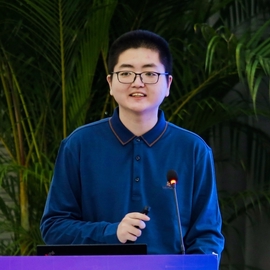
Zizheng Guo
Ph.D. Student
I am a Ph.D. candidate at Peking University. My research interests include data structures, algorithm design and GPU acceleration for combinatorial optimization problems.