Abstract
Timing optimization following clock tree synthesis (post-CTS) is a crucial step in very large scale integration (VLSI) physical design for achieving timing closure. During this stage, clock skew significantly impacts circuit timing performance, making useful skew optimization essential for enhancing design quality. However, traditional skew optimization methods face challenges due to their insufficient consideration of physical implementation constraints. To overcome these limitations, we propose a GPU-accelerated differentiable concurrent clock and data (CCD) optimization framework, which simultaneously optimizes clock skew and logic delays to enhance overall timing performance with the consideration of physical constraints. We implement the CCD optimization method as a step involving buffer sizing in the clock network and refining placement results. The key innovation of our approach lies in formulating a smooth and differentiable process for CCD optimization with a calibration mechanism to ensure accurate gradient computations. Additionally, we employ an alternating direction method of multipliers (ADMM)-based strategy to decompose the entire optimization problem into several manageable subproblems, effectively balancing timing optimization with physical implementation constraints. Experimental results on open-source industrial benchmarks demonstrate that our CCD optimization framework achieves superior timing closure compared to a baseline approach within an open-source physical design tool. Our method yields an average improvement of 22.4% in worst negative slack (WNS) and 45.0% in total negative slack (TNS), along with a 9.434× runtime speedup. To our knowledge, this is the first work to incorporate clock skew effects into gradient-based timing optimization.
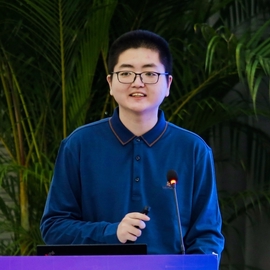
Zizheng Guo
Ph.D. Student
I am a Ph.D. candidate at Peking University. My research interests include data structures, algorithm design and GPU acceleration for combinatorial optimization problems.